
The BJP would seem just the sort of party that would embrace Aadhaar. Every other page of its manifesto makes some reference to changing governance in this country. So why is there no discernible difference in the positions of the BJP-led government towards Aadhaar and the dysfunctional approach of Chidambaram under the United Progressive Alliance, asks Rahul Jacob.

The current crisis Karnataka Chief Minister Siddaramaiah is facing is a cumulative effect of inattention to water management and the fiscal burden of populist promises, says Aditi Phadnis.

'The Indian economy has been subsidised by the poor.'
An asset swap can simultaneously boost public investment, reduce the fiscal deficit and keep fiscal policy from being pro-cyclical.
It is not a good idea to take the line that since demonetisation happened in the third quarter, everything that happened then was a consequence of that, says Chief Statistician TCA Anant.

The government has unleashed a slew of reforms to attract greater investments including higher foreign direct investment in defence and opening up the railways infrastructure sector, relaxed labour laws, launched campaigns like the Make in India for re-invigorating manufacturing, Clean India and Digital India, among others.

IMF attributes the slower growth rate to supply-side bottlenecks.

More people will be literate, on the Internet, linked to the national identification scheme and likely to receive electricity, especially from alternative-energy sources.
Finance Minister Arun Jaitley has said that the states were free to announce farm loan waivers if they had the fiscal space and that there would be no shortfall this year in divestment and non-tax revenues.

Moody's listed six agenda on the list of pending reforms -- land acquisition Bill, labour law reforms, significant infrastructure investment, tangible benefit from Make in India initiative, tax administration and PSU bank reforms

'It has a natural inclination to foster as much competition among civilian politicians as possible.'

Attired in his trademark half sleeves kurta and sporting a Rajasthani turban, Prime Minister Narendra Modi devoted a bulk of his 90-minute address on the occasion of the 70th Independence Day to presenting in effect a report card of his government's work particularly in boosting economic growth, ease of doing business and welfare schemes for the poor and farmers.

Many things could play spoilsport for the Indian economy.

With Jaitley preferring continuity over change, good days might take a little longer to arrive, says Shankar Acharya.

Finance Minister Arun Jaitley on Monday presented the Union Budget for 2016-17.

It could also clear stalled projects and review various subsidies on the energy, food and fertiliser fronts.

The passage of the Bankruptcy Code could set the stage for other important legislation that may see India undergo more economic change than all governments combined since the reforms implemented by P V Narasimha Rao in 1991-93, says Ben Merton.

It maybe time for the Centre to take a closer look at Chief Minister Jayalalitha's innovative' solution to a long-pending problem, says N Sathiya Moorthy.

Partial dismantling of subsidies, movement towards a more transparent policy on natural resources and moves to make India more inviting for foreign investors, are some of Modi government's big achievements.

It was the rejection of the Congress' welfarist economics by voters that led to the party's drubbing, says Andy Mukherjee.

Economist Arvind Panagariya tells Suman Guha Mozumder that the rupee is doing a much-needed clean-up job, raising exports and cutting imports.

Rahul Gandhi slammed the Modi government, accusing it of being against farmers, labourers, students and the poor.

The prime minister's August 15 address was undoubtedly inspirational and outlined important economic and social objectives, such as making India a global hub for manufacturing, ensuring bank accounts for all poor families, major thrusts in sanitation and cleanliness, and a radical restructuring of the Planning Commission.

Businessmen love low import duties on their inputs and high duties on their outputs. And the Bharatiya Janata Party has a keen ear for business sentiment.

The BJP government is no better than the Congress -- as wretched and anti-people. In addition, it is explicitly and aggressively communal, says Venkatesh B Athreya, in a hard-hitting interview to Shobha Warrier/Rediff.com.
AAdhar cannot be successful unless there is proper coordination at the helm.
Ministers in the Narendra Modi government have been busy making presentations on their 100 days of work. But what these presentations do not mention is that decisions by ministers have been few, with plenty of papers and files moving to the Prime Minister's Office, which is increasingly emerging as a centralised clearance point, even for routine and ordinary issues. Though policy paralysis was a term used freely for the United Progressive Alliance regime, questions are now being raised about pending decisions across ministries and whether at least some ministers have turned redundant.
In Budget 2015, the finance minister has opted to take the slow road and has doubled the cess on coal to "balance the need to tax pollution and the price of power" in his words.

Are we adopting an idea whose time has come and gone? My feeling is, yes, says ex-banker C Joseph Chacko in the fourth article of the series on inflation targeting.
Petroleum and Natural Gas Minister Dharmendra Pradhan speaks to Sheela Bhatt/Rediff.com.

Despite criticism of a lack of transparency and communication from the Modi-led government, BJP leaders point to "good beginnings" on several fronts to defend its performance. Sheela Bhatt/Rediff.com reports.

The Cuban government has announced nine days of mourning and has set Castro's funeral for December 4.

'He is anything but astute or charismatic. He believes the Congress can win elections without alliances in the Hindi heartland.'

Anshu Gupta, the founder of Goonj, has transformed the culture of giving in the country. He has for 15 years now, worked tirelessly to bridge the gap between the haves and the have-nots, by making discarded materials a resource for the poor. His weapon, he says, is 'cloth as a tool of social change.'

This Budget signals a shift from a hand-out to a hand-up economy.
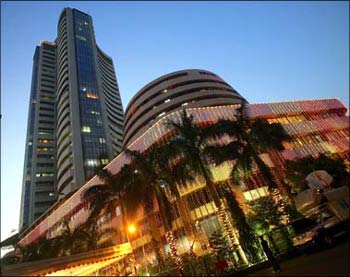
'There is no change in the overall story of economic recovery.'
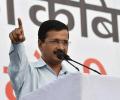
Kejriwal has shown once again that a political party once mandated to ensure governance cannot act the same way it did before assuming power.

'There were 10-15 JNU guys who came in fake lawyer dress and instigated the violence. They want to give us a bad name.' 'When someone holds my brother lawyer's neck must I wait for permission from the media and the police to beat the attacker?' 'These JNU guys are raising anti-India slogans and I am saying Hindustan Zindabad and you say I have created problems.' Lawyer Yashpal Singh tries to explain the violence outside a Delhi court.

'Rahul Gandhi accuses the Modi government of being in thrall to corporate fat cats at the expense of farmers and other common folk. But the facts do not bear out this argument, as Indian farmers are relatively better off compared to the really wretched of the earth, the unfortunate landless, often itinerant, labourer. And since Rahul's ancestors are the ones who failed them, it is a little disingenuous of him to ignore them in his rhetorical flourishes,' says Rajeev Srinivasan.
